 Commustat

October was a month in which a relatively large number of companies moved their headquarters. Persol Tempstaff moved its head office to Shinjuku Eastside Square on October 5 and announced that it will gradually consolidate its Shinjuku, Shibuya and Ikebukuro offices into the new headquarters. Gurunavi moved to the Imperial Hotel Tower on October 13, citing as one reason the goal of making its hybrid work style, combining office and remote work, function more effectively. Nagase & Co. also brought together about 1,500 employees from 16 group companies, previously spread across several buildings, into a single new building in Nihonbashi Kobunacho.
A growing number of companies are consolidating scattered offices into one and rebuilding the office as a place where people gather. I feel that precisely because working from home has taken root, the meaning of office days is being questioned, and more companies are investing in offices that can serve that purpose.
Where people want to live depends on where the office is
Most of these relocations were consolidations within central Tokyo. So when the location of an office changes, where will most employees end up living? For each office's nearest station, I counted how many "stations within easy commuting reach" there are when arriving at 9 a.m. (Here, "stations within easy commuting reach" means stations with a Commute Burden Index of 30 or less.)
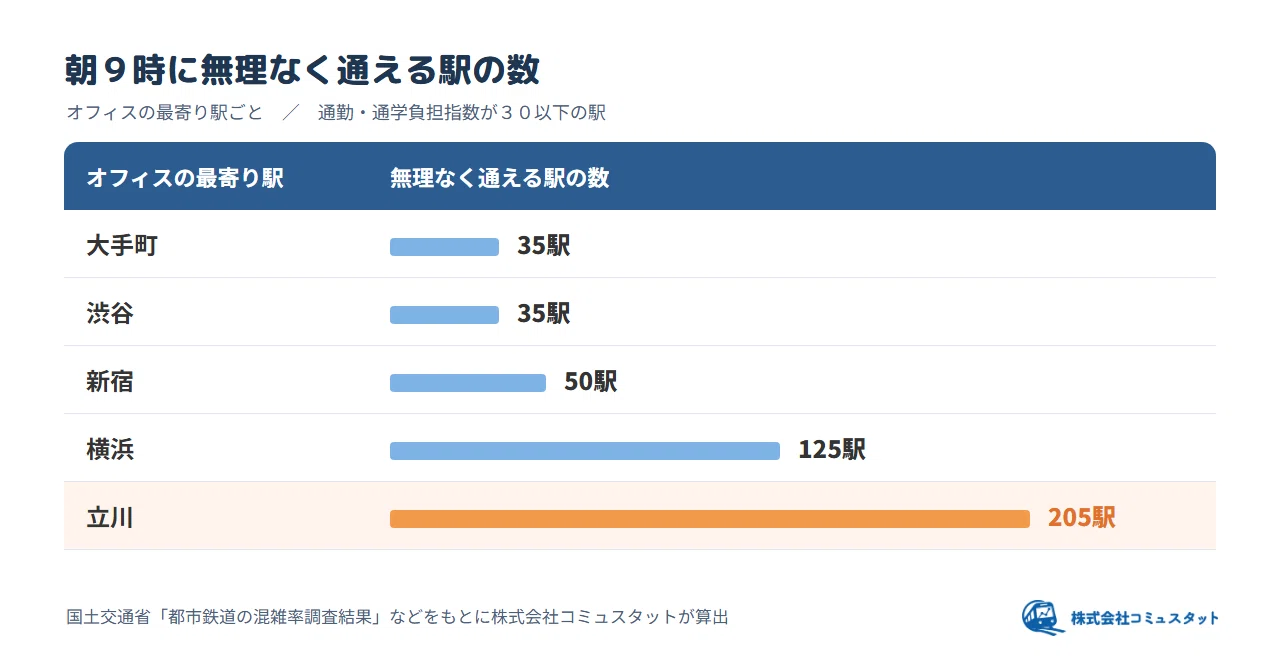
Almost all of Otemachi's 35 stations are in central Tokyo, in wards such as Chiyoda, Chuo and Bunkyo. With Tachikawa, in addition to stations in the Tama area such as Kunitachi, Hino, Akishima, Kokubunji and Fuchu, you can also commute easily from Kichijoji and even Shinjuku. This is because trains heading into central Tokyo run in the direction of the morning rush, while trains to suburban hub stations run against it.
Rents also differ greatly. According to the Ministry of Internal Affairs and Communications' 2023 Housing and Land Survey, the rent per tatami mat for private rental housing is 9,566 yen in Chiyoda Ward and 8,997 yen in Chuo Ward. By contrast, it is 4,907 yen in Tachikawa City, 4,342 yen in Hino City and 3,904 yen in Akishima City, about half the level of central Tokyo.
If the office is located at a suburban hub station, employees can live in areas with lower rents while still commuting with ease. For employees, it widens the choice of where to live, and for the company, it could also be an opportunity to review housing and commuting allowances.
Sources
• Persol Tempstaff, "Head Office to Move to Shinjuku Eastside Square on October 5" https://www.tempstaff.co.jp/corporate/release/2026/20260515-12581.html
• Gurunavi, "Notice of Head Office Relocation" https://corporate.gnavi.co.jp/release/2026/ccqm6a83ll/
• Nagase & Co., "Completion of the New Tokyo Head Office Building and Office Relocation" https://kyodonewsprwire.jp/release/202610057249
• Statistics Bureau, Ministry of Internal Affairs and Communications, "2023 Housing and Land Survey," Table 121-2-2 (Rent per Tatami Mat) https://www.e-stat.go.jp/dbview?sid=0004021488
#HeadOfficeRelocation #OfficeRelocation #Commute #WorkStyle #Housing
A free tool that makes commuting burden visible with indices. No sign-up needed.
Think about your office location