 Commustat

The regulation that prevents universities in Tokyo's 23 wards from increasing their enrollment capacity expires at the end of March 2028. It is a temporary measure introduced in FY2018 to protect regional universities. The government is considering whether to extend or abolish it through an expert panel, and on October 8 the Tokyo Metropolitan Assembly unanimously adopted a written opinion calling for its abolition.
With an eye on where the regulation is headed, plans to bring campuses back to central Tokyo already seem to be under way. For example, in April 2023 Chuo University moved its Faculty of Law from Tama to the Myogadani Campus in Bunkyo Ward, which drew attention as its first return to central Tokyo in 45 years. Jissen Women's University has announced a plan to consolidate the faculties at its Hino Campus into its Shibuya Campus by around April 2031.
Same home, same 30 minutes or so. Only the direction is different
I used Campus Life Indicator to test whether moving a campus to central Tokyo makes it easier to commute to. The case is traveling from Mitaka Station to two different stations, arriving in time for 1st period (8:40). Both can be reached on a single JR Chuo Line Rapid train, and the ride times are almost the same.
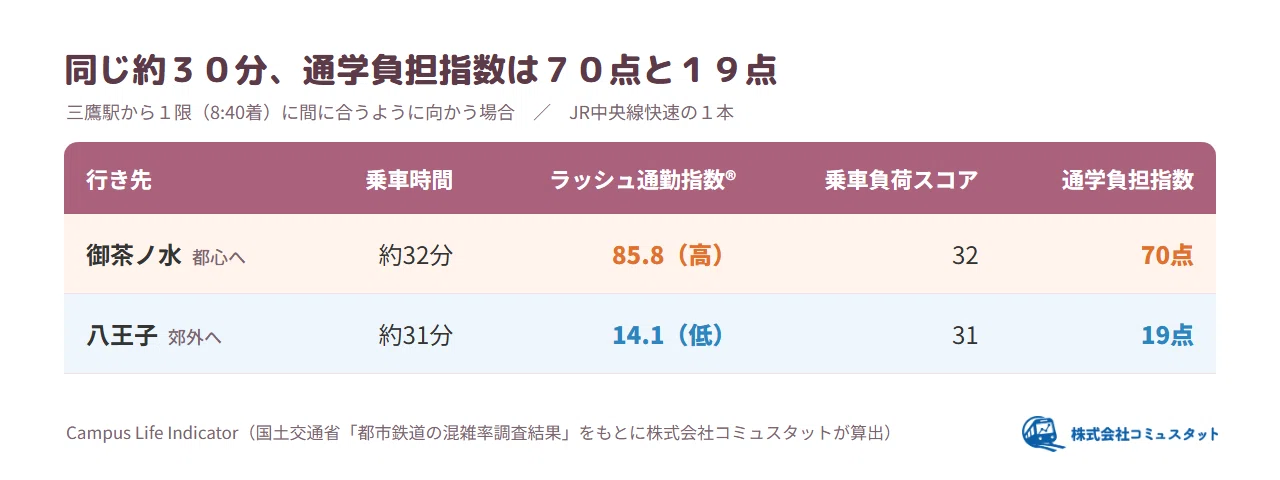
Although the ride time is the same, the Commute Burden Index is 70 points for one and 19 points for the other, a large difference. For trains heading into central Tokyo, the time window for making 1st period coincides exactly with the peak of the rush. Trains heading out to the suburbs run against the flow of congestion. There have also been reports that attendance rose after a campus moved to the suburbs, and I believe the burden of getting to school cannot be measured by distance or travel time alone.
When thinking about where a campus should be
Campus Life Indicator is a service that, once you choose a campus, color-codes on a map the stations from which it is easy to commute there and lets you check six figures for each station. Whether prospective and new students are choosing where to live or universities are considering reorganizing their campuses, it makes it possible to keep in mind the daily morning burden on students.
If, at the stage of considering where a campus should be, it is possible to check what kind of mornings students will have, I believe this will lead to a better learning environment.
Sources
• Cabinet Secretariat, Expert Panel on Reviewing the Implementation of the Act on the Promotion of Regional Universities https://www.chisou.go.jp/sousei/meeting/chiiki_daigakuhou_yuushikishakaigi/dai1/r08-06-04.html
• ReseEd, "Tokyo Metropolitan Assembly Adopts Written Opinion Calling for Abolition of Enrollment Cap on Universities in the 23 Wards" https://reseed.resemom.jp/article/2026/10/09/14317.html
• Chuo University, "Myogadani Campus to Open in April 2023" https://digitalpr.jp/r/51858
• Jissen Women's University, "All Faculties to Be Consolidated at the Shibuya Campus by Around April 2031" https://www.jissen.ac.jp/notice/year2025/20251217_1.html
• Toyo Keizai Online, "Moving from Central Tokyo to the Suburbs Sent Attendance Soaring..." https://toyokeizai.net/articles/-/948218
#University #SchoolCommute #ReturnToCentralTokyo #CampusLifeIndicator #RushCommuteIndex #CommuterTrainAnalyst
A free tool that makes commuting burden visible with indices. No sign-up needed.
Find an easy-to-commute area